

SEND information
Widden Primary School is ambitious for all our children and we believe that there is no ceiling on what can be achieved by anyone, regardless of their circumstances or background. We are committed to providing a supportive and inclusive learning environment, giving every young person the opportunity to fulfil their potential now, and in the future.
The leaders at Widden Primary School are leaders for all children, enabling our teachers to be teachers of all. Widden Primary School is committed to distributed leadership to secure the best possible provision and outcomes for children with special educational needs. We have the same ambition for all our children, and recognise the importance and impact of prioritising our responsibilities to those with special educational needs.
We work in partnership with children and their families in identifying and providing for special educational needs. Where appropriate, we also work in partnership with other agencies. We recognise the importance of communication being inclusive, accessible and culturally sensitive to achieve effective partnership working.
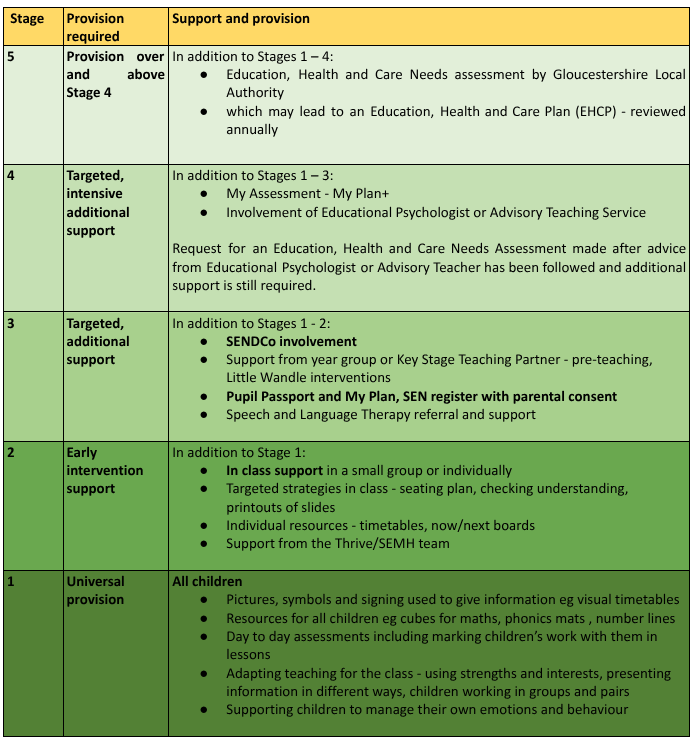
The graduated approach
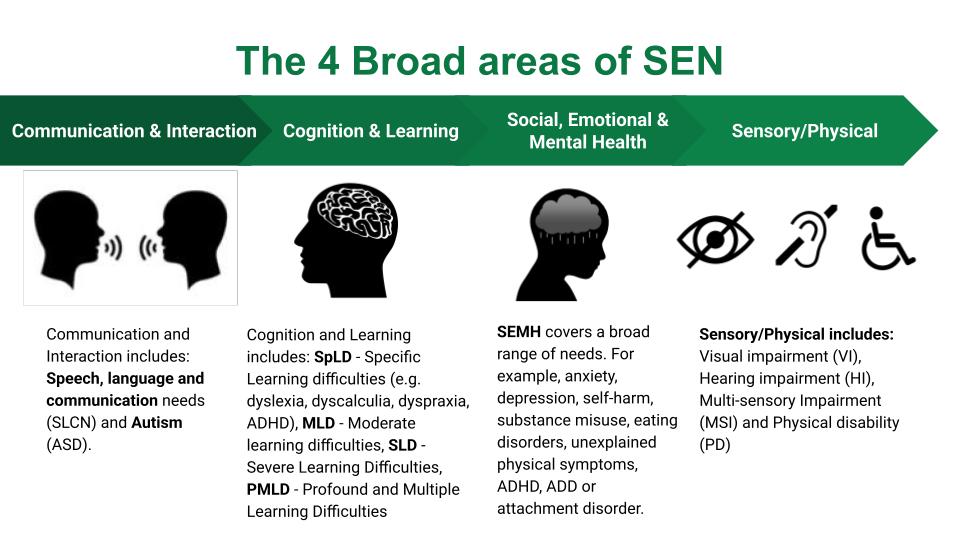
What does it mean to have a Special Educational Need?
What does it mean to have a Special Educational Need?
A child has SEN if they have a learning difficulty or disability that requires special educational provision to be made for them.
They have a learning difficulty or disability if they have:
-
A significantly greater difficulty in learning than most others of the same age; or
-
A disability that prevents or hinders them from making use of facilities of a kind generally provided for others of the same age in mainstream schools.
Special educational provision is educational or training provision that is additional to, or different from, that made generally for other children or young people of the same age by mainstream schools.
What this means at Widden Primary School
We support all children, including those with SEND by using high quality teaching strategies which include modeling, breaking information up into smaller 'chunks', repeating instructions, checking for understanding and allowing time to respond. A Total Communication approach, Widgit symbols and visual timetables are used across the school as appropriate to the needs of children in each class. Children with SEND all have a child passport and a My Plan or My Plan+. The child passport includes strategies for each child and details of any adaptations or adjustments that are required to ensure the child can access the learning.
Our SEND Team
|
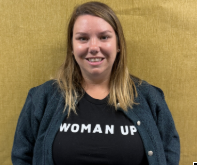
Miss Morix |
I am committed to ensuring that all children with SEND at Widden Primary School are able to aspire, believe and succeed. I am dedicated to empowering our teachers with the skills and resources they need to meet each pupil's unique needs. By providing a supportive school environment which enables them to access learning, we ensure that all children get the right support to reach their full potential and truly flourish. |
|
|
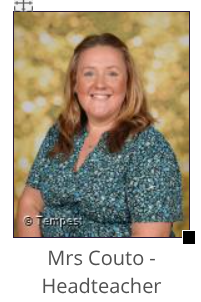
As headteacher of a diverse and inspiring community, I am committed to ensuring the highest aspirations are held for every single child, irrespective of background, SEND or prior attainment. We recognise that children learn in different ways and at different rates, and our SEND provision is built around understanding individual needs, celebrating strengths, and removing barriers to learning. Through close partnership with families, skilled staff, and specialist services, we create an inclusive environment where pupils feel safe, confident, and able to achieve their full potential — academically, socially, and emotionally. |
Identification and assessment of children with SEND
We work in close partnership with families and local settings. Many children with special educational needs will therefore be identified through the transition and induction process.
Transition to school is carefully planned to give time for observations and assessments of children as they join the school. Where there are any concerns with regard to a child’s development against developmental milestones, the school will speak with the parent to identify next steps.
A child has SEN where their learning difficulty or disability calls for special educational provision, namely provision different from or additional to that normally available to children of the same age. (SEN Code of Practice, 2015)
Parents/carers are informed when children are added to or removed from the SEN register. When deciding whether special educational provision is required, we will start with the desired outcomes, including the expected progress and attainment, and the views and aspirations of the child and their parents/carers. We will use this to determine the support that is needed and whether this can be provided by adapting our core offer, or whether something additional is needed.
We will assess each child’s current skills and levels of attainment on entry, which will build on previous settings and Key Stages, where appropriate. Class teachers will make regular assessments of progress for all children and identify those whose progress:
-
Is significantly slower than that of their peers starting from the same baseline
-
Fails to match or better the child’s previous rate of progress
-
Fails to close the attainment gap between the child and their peers
-
Widens the attainment gap
-
Demonstrates high levels of dysregulation
This may include progress in areas other than attainment, for example, social needs. Attendance and behaviour data might also be used to identify which children require additional support.
Slow progress and low attainment will not automatically mean a child is recorded as having SEN.
Where a parent/carer has a concern about their child, parents are asked to speak with the class teacher so that appropriate observations and assessments can be undertaken.
Assessments will also take into account the child’s past educational experiences and whether they are learning English as an additional language.
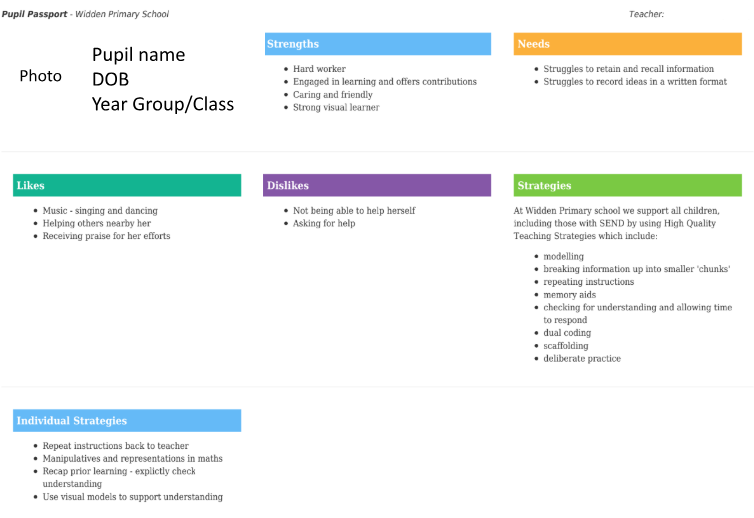
Pupil Passport
A pupil passport is a regularly reviewed document that contains the needs, strengths and individual strategies for every child with an EHCP or on SEN Support. These are developed in partnership with children and their parents/carers. Where appropriate, they might also include strategies recommended by other professionals.
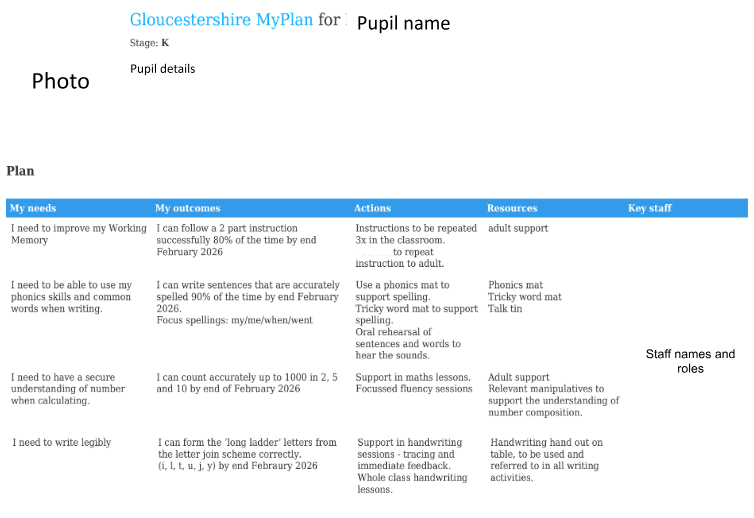
Learning plan
Some children who require more specialised support will have Individualised learning plans to complement child passports. For example, an individualised learning plan will be used to:
-
Track progress against long-term outcomes in Educational, Health and Care Plans (EHCNAs) for children working below age related expectations
-
Inform medium-term and daily curriculum planning and provision where children are accessing adapted curriculum pathways
-
Inform intervention planning
-
Universal provision – high quality teaching
Widden Primary School ensures that a universal provision of high quality teaching is able to address gaps in foundational knowledge and skills. Through evidence informed classroom routines and a well planned curriculum, teachers are able to address reading fluency and accuracy, communication and language skills, writing composition and number facts. Furthermore our carefully selected and sequenced curriculum ensures foundational subject specific knowledge is secure at every step. For some children, effective in classroom targeted support ensures gaps are identified and tackled quickly through our responsive and adaptive classroom practice
Targeted support
At Widden Primary School, we offer the following interventions:
- Thrive
- Time to Talk
- Plus 1 and Power of 2 maths interventions
- Read Write Inc one-to-one tutoring sessions
- Precision teaching
- In class interventions such as pre-teaching, 1-1 reading
Where appropriate, teachers are made aware of the focus of any intervention so that they can support children to generalise the skills learnt back to the classroom.
Interventions are reviewed every short term to check the impact against the intended outcome. Where the intervention is not having impact as expected, changes will be made to the intervention.
Specialist support
At Widden Primary School, we work in partnership with a range of external agencies, and they support the planning and delivery of specialist interventions. This might include mentoring, specialist speech and language therapy sessions focused on speech sounds or access to specialist mental health support.
Specialist interventions include:
- Thrive (1-1 or small group)
- Attention Autism
- Sensory circuits
- Language for Thinking
- South Warwickshire motor skills programme
Interventions are provided by professionals such as speech and language therapists, physiotherapists and occupational therapists.
Where appropriate, teachers are made aware of the focus of any intervention so that they can support children to generalise the skills learnt back to the classroom.
Interventions are reviewed at least every short term to check the impact against the intended outcome. Where the intervention is not having impact as expected, changes will be made to the intervention.
Staff training
I have been teaching for 16 years across a range of schools, both in the UK and abroad, holding senior leadership positions in each of them. Having taught across all key stages and phases, I bring a deep understanding of a child's entire educational journey. Dedicated to continuous professional development, I have completed the NPQLT and NPQSL, and am excited to be beginning the NPQSENCO this year.
I have four days a week dedicated to managing our SEN provision, alongside leading writing across the school, ensuring pupils have the leadership and support they need to thrive.
We have a team of 26 teaching partners and two nursery practitioners (level 3) including two higher level teaching assistants (HLTAs) who are trained to deliver SEN provision.
One of our teaching partners is a trained Thrive Practitioner.
Staff have been trained in Thrive, Attention Autism, Team Teach, Lego therapy, Language for thinking, Read Write Inc, Chatterbugs, precision teaching and Total Communication.
We use specialist staff for play therapy and counselling.
Useful links
SENDIASS - Independent advice for parents of children with SEND: https://sendiassglos.org.uk/
Gloucestershire Parent Carer Forum: https://www.glospcf.org.uk/
Dingley's Promise – support for families of Early Years children with SEND:
https://dingley.org.uk/resources-for-families/
Teacher Handbook: SEND
With contributions from specialists across the sector, the handbook is a comprehensive resource for teachers and parents to use over time. It brings together practical examples of high-quality teaching - placing focus on removing barriers to learning, getting to know and understand individual learners, and bringing to life the graduated approach.
To access this free resource, click on the link below and sign up to Whole School SEND:
https://www.wholeschoolsend.org.uk/teacher-handbook
Whole School SEND Online CPD Units
Free, flexible online learning to help develop inclusive practice. https://www.wholeschoolsend.org.uk/page/online-cpd-units
Our SEN Information Report and Accessibility Plan can be found on the school documents and policies page here.
To view our Local Offer, please click on the link below.